Srbobran
Beljanska bara is located in central Bačka, in the area where the river Krivaja flows into the Great Backa Channel. It is formed from several shallow valleys that meet three kilometers north of Starobečej’s farmsteads, then flows in the southwest, cutting backa’s loess terrace. Unashamed at its mouth, it approaches Krivaja at a distance of 400 m, then flows parallel to it, and at the end both flow into the Great Bačka Canal near Turija. The maximum measured water depth is 2.8 m, while the annual fluctuation of water level ranges from 30 to 40 cm. Since 1964, the Beljanska bara has been regulated over a length of 16 km, which enables better drainage of water from the surrounding valleys and depressions. It extends over the territory of the municipalities of Srbobran and Bečej. In 2013, the nature park “Beljanska bara” was declared a protected area and entrusted to the management of JVP “Voda Vojvodina”, in which two protection regimes were established: protection regime II degree, area 89.38 ha, and the protection regime of the Third degree, with an area of 83.73 ha, which together makes 173.12 ha of total area of the nature park, while the protective zone around the Nature Park covers an area of 325.82 ha.
Regarding the flora of the pond, 9 species and 2 subspecies of nationally and internationally important taxa were recorded. Of these, in the Rulebook on the Proclamation and Protection of Strictly Protected and Protected Wild Species, 3 species and one subspecies are listed in the strictly protected category: Tabernemontan’s sedge (Scirpus lacustris subsp. tabernaemontani), marsh fern (Thelypteris palustris) and marsh nettle (Urtica kioviensis). and 5 species are in the protected category: ijirot (Acorus calamus), Pannonian star (Aster tripolium subsp. pannonicus), two types of honeysuckle (Utricularia australis and Utricularia vulgaris) and toadstool (Zannichellia palustris). One species, the water fern (Salvinia natans), is listed in Appendix I of the Berne Convention as strictly protected.
The animal world is represented by a significant number of species, many of which are protected. The fish stock consists of 23 species of fish from 8 families, and according to the first available data on the composition of the ichthyofauna in Beljanska Bara from the 1960s, the following were recorded: carp, perch, crucian carp, tench, redfin, whitefin, bream, pike, perch, manjov and rare specimens of catfish. From the list of the Rulebook on the Proclamation and Protection of Strictly Protected and Protected Wild Species, as many as 11 species have been recorded in Beljanska Bara: among the strictly protected species are golden carp (Carassius carassius), tench (Tinca tinca) and chikov (Misgurnus fossilis), while from the list of protected species present pike (Esox lucius), bream (Abramis brama), black-eyed bream (Abramis sapa), bream (Aspius aspius), carp (Cyprinus carpio), catfish (Silurus glanis), perch (Perca fluviatilis) and perch ( Sander walleye).
Seven species of amphibians and five species of reptiles were also recorded, of which the following species are strictly protected according to the Ordinance: pond turtle (Emys orbicularis), loggerhead (Natrix natrix), small marmot (Lissotriton vulgaris), red-bellied toad (Bombina bombina), green toad ( Pseudepidalea viridis) and cricket (Hyla arborea). The protected species encountered are: green frog (Pelophylax kl. esculenta), small green frog (Pelophylax lessonae) and large green frog (Pelophylax ridibundus).
The Beljanska pond is an important habitat for several species: blue vole (Cyanecula svecica), gray pond grouse (Zapornia parva) and bearded sage-grouse (Panurus biarmicus). 136 species are registered, of which 71 species are strictly protected, 51 species are on the SPEC list (Species of European conservation concern – species important for protection in Europe), and 32 species require special habitat measures – Emerald area. 8 species of heron were recorded, especially the purple heron (Ardea purpurea), whose colony existed until recently, but is no longer there, then the mallard duck (Aythya nyroca), as well as the little crow (Phalacrocorax pygmeus), which are on the World Red List. Individuals of the blue vole (Luscinia svecica), a very rare species, of which there are 500 to 730 pairs in Serbia, were also observed.
The fauna of mammals consists of species that are related to life in or near water. Among the bubo-eaters, the presence of the hedgehog (Erinaceus concolor), the mole (Talpa europaea), and the water shrew (Neomys fodiens), which is a strictly protected species, was recorded.
Among the animals from the order of rodents, the Bizham rat (Ondatra zibethica), the water vole (Arvicola tererestris), the field vole (Microtus arvalis), the house mouse (Mus musculus) and the gray rat (Rattus norvegicus) were observed.
Among the animals, badger (Meles meles), ferret (Mustela putorius) and weasel (Mustela nivalis), which is a strictly protected species, were observed. The dog family is represented by two species: the widespread fox (Vulpes vulpes) and the increasingly numerous jackal (Canis aureus). The otter (Lutra lutra) is a strictly protected species in Serbia, and according to the IUCN categorization, it is marked as vulnerable, and its population is stable in Beljanska Bara. Of the hunted game, rabbit (Lepus europaeus), roe deer (Capreolus capreolus) and wild boar (Sus scrofa) were registered in smaller numbers, and the hunting area belongs to the territory of the hunting grounds “Bečejski Salaši” and LU “Turia”.
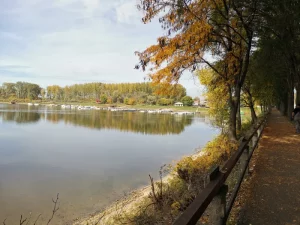
There is no place with a stronger potential for the development of rural and eco-tourism than the one offered by the Beljanska Bara Nature Park and its surroundings. In one place, in the oasis of peace that the large bodies of water and the plains of Vojvodina bring with them and exude, a fantastic environment for rest, enjoyment of pure nature, conditions for active time in hunting, fishing, recreation and other activities meet. Eco-tourism is developing more and more, so in 2013, an Eco-classroom was opened in the Beljanska bara Nature Park, which still gathers students from local schools today. Also, along the left and right shores of the first of the three pools (viewed upstream from the mouth) that make up the entire Nature Park, a 2 m wide and 4.2 km long Health Trail was built in 2015. It is located in an area that is under the III degree protection regime and has an educational and recreational character. However, it is necessary to enrich all the existing contents and with regular maintenance breathe new life into this fantastic space that offers great possibilities.