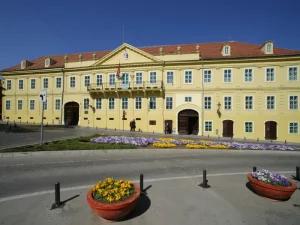
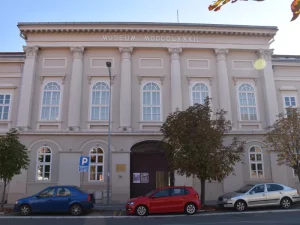
Cara Dušana 2, 24000 Subotica

Web site: https://www.subiblioteka.rs/
City library Subotica as one of the oldest institutions in Subotica and its organizational structure
City library Subotica is one of the oldest cultural institutions in the town. It is a public library and the central library for the territory of Subotica, Bačka Topola and Mali Iđoš. The library provides services to its users in the Loan, Children’s, Scientific and Homeland Departments and also in American Corner, which operates with the support of the U.S. Embassy in Serbia. In addition, there are seven active branches in Subotica and its surrounding: in Aleksandrovo, Bajmok, Čantavir, Novi Žednik, Palić, Stari Žednik and Tavankut.
History
The City Library of Subotica was founded in 1892 on the initiative of István Iványi (1845-1917), who was the founder and first librarian of the City Library as well as the author of the grand monograph “History of the Free Royal City of Subotica”. From a small collection of a few hundred books, in 133 years,the library has grown into a library that possess about 400,000 books and 6,000 periodical publications and other library material. During the 133 years of its existence, the Library was moved to several places, from the Courthouse, the Gymnasium, the Music School, then the former Faculty of Law (today the School of Chemistry and Technology), to Sokolski dom (today “Jadran”), and was relocated once again, to the Music School, from which it was moved in 1953 to the current building.
Special collections
City Library of Subotica has an extremely valuable collection of old and rare books, among which it keeps 6 incunabula – books from the 15th century – and most of them are from the personal libraries of the bibliophile Dr. Vincze Zomborcsevics(1810-1900) and Izidor Milko (1862-1907) and other prominent citizens. 166 books from the 16th century and 222 books from the 17th century are kept here.
The most used and most important collection of the library is the homeland collection, which is kept mostly in the Homeland department and partially in the Scientific Department. For people showing interest in studying homeland history and all segments of life, the homeland collection is a Must-Read.
Digitization – steps for the future
In recent years, the library has started to digitize the materials of the homeland collection, starting with periodical publications. Part of the digitized materials is available on the website: https://digitalna.subiblioteka.rs.
The library has been expanded in recent years and thanks to the Bethlen Gábor Alap from Hungary, on the order of the Secretariat for National Policy of the Government of Hungary, it got a new reading room, a two-story courtyard building, intended for searching digitized materials and for research work, as well as for educational programs and cultural events.
70 years in the building of the former National Casino
In 2023, the Library will celebrate its 70th anniversary since moving into this building, the one of the former National Casino, which was built in 1896 and has the status of a cultural monument of great importance. By moving into this building, the conditions for organizing and cataloging funds, for adequate accommodation of library material, and for the formation of departments designed to serve users of various needs and ages were obtained. In the 70s, the building was adapted for new needs, i.e. in 1973/74 the adaptation was carried out, gallery spaces were built, thereby providing space for an increasing number of books and periodicals.
The building was built according to the project of Ferenc Raichle (1869-1960). It represents a corner building designed in the spirit of eclecticism. At the entrance from the city center, there are figures of two Telamons, the work of sculptor Ede Telcs, who carry the balcony of the first flooron their shoulders. In 2022, the front facade was restored. The reading room and the staircase leading to it are extremely luxurious. At the turn of the 19th and 20th centuries, it was originally intended for the social life of Subotica intellectuals who were gathering in the National Casino as the part of the Free Lyceum. Dezső Kosztolányi (1885-1936), the great Hungarian writer born in Subotica, describes the social circumstances and the ambience of this room in his novel “Pacsirta” (“The Skylark“).