Vojvoda Stepa
This specific village was founded in 1923 by the colonization of people from different parts of the Kingdom of Serbs, Croats and Slovenes (the colonists were mostly Serbian volunteers from the Thessaloniki front) and the settlement of Serbian settlers from Hungary and Romania.
For the first few years, the village was called Leonovac after the son of Count Čekonjić, on whose property it was founded, and in 1927, Serbian volunteers named the village after their commander from the Thessaloniki Front – Duke Stepa Stepanović.
Since 1988, the square in this settlement has been decorated with a bust of the famous Serbian duke. It is a monumental bust in bronze with a similarly designed pedestal made of rustically worked stone, on the front of which the name of the duke and the years of his life are written in cast bronze letters.
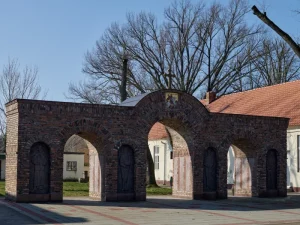
A year later, a memorial was erected with the names of 396 volunteers who participated in the First World War, who were the first residents of the established village. It is an arched wall built of roughly hewn stone on which 33 bronze plaques with names are placed in three rows.
The two units are connected to each other in a complex, and this monument named “Yugoslav volunteers of the Serbian army from the First World War on eternal guard with their duke” is the work of Nikola Kolje Milunović, an academic sculptor from Belgrade.
In 2018, the square was ennobled by a howitzer from 1918, which was a gift from the Military Museum in Belgrade. It is an artillery weapon that was used during the liberation of Serbia in the First World War.