Sutjeska 27, Neštin, Bačka Palanka
Category:
a cultural monument of exceptional importance for the Republic of Serbia
Decision on protection No. 01-283/68 of May 21, 1968, Novi Sad
Categorization: “Official Gazette of RS” No. 16/90, December 3, 1990
RS state property right of use Provincial Institute for the Protection of Cultural Monuments, Petrovaradin the state of the object
In 2012, the cultural property was conserved, restored, and renovated
Maintenance works were performed in 2013, 2015, and 2022.
In 2012, works were carried out on the repair, conservation, and restoration of the Savić house, the installation of a fence in the traditional wattle technique, and the Barn was purchased and transferred on the sleighs from Susek.
2013
- building a replica of the Susek house with a stable
- building a bread oven with a smokehouse
- renovation, conservation, and restoration of the Barn from Susek
- works on the ongoing maintenance of the Savić house
- During the year, to equip the house, the action of purchasing furniture was carried out.
In 2014, works were carried out on the construction of a replica of the Čerević House, water was brought to the plot and a field toilet was built. Savić house is equipped and furnished with purchased and donated furniture.
In 2015, an outbuilding, a pigsty from Susek was purchased, dismantled, assembled, renovated, and conserved at the location of the Savić house plot. And on the lower plot, in the proximity of the Čerević house, sanitary facilities with a toilet were built for visitors and users of the complex.
In 2020, the document called Disaster Risk Assessment of the Open Air Museum Complex “Savic house” in Nestin was completed within the Project of the Ministry of Culture and Information Disaster Risk Management in the Field of Cultural Heritage – Second Phase, supported by the UNESCO Participation Program 2018-2019. The realization of the project resulted in the elaboration of Disaster Risk Assessment and Emergency Protection and Rescue Plans for – Studenica Monastery, ongoing Open Air Museum Complex – House of Savić house in Neštin and Matica Srpska Gallery.
In 2022, works on the ongoing maintenance of all facilities of the complex were carried out.
NEŠTIN
Nestin, a village in Western Srem, situated on the slopes of the Fruška Gora and the banks of the Danube, is rich in natural beauty and cultural heritage. Having an important geographical position, and being a meeting place of different civilizations and cultures, the village has influenced numerous historical events, legends, and traditions.
This area of the Pannonian Plain was inhabited as early as the early Stone Age, and the Celts, Romans, Avars, Hungarians, and Slavs left their mark. The most significant are the remains of the Roman civilization, with the imperial city of Sirmium nearby, the beginnings of vine plant-ing, and wine production. Numerous archaeological sites with exceptional finds were discovered in the vicinity of the settlement, and “Kuluštra” stands out among them.
Nestin is also rich in natural resources, springs, and viewpoints such as Gornja ada (Upper isl-and), Plaža pesak (Sandy Beach), Zeleno ostrvo (Green Island), Podrumi( Cellars), Donji kamen (Downstream rock ), Vinska terasa (Wine terrace).
It is surrounded by beautiful and colorful landscapes, along the Danube bank and around the settlement, whose territory borders the Fruška Gora National Park. The medieval monasteries of Đipša, Šišatovac, and Kuveždin are in the immediate vicinity.
Today, there are several marked cycling and walking trails in and around Neštin. The starting point of the wine route is this secluded place, which has the potential to become a center of rural tourism.
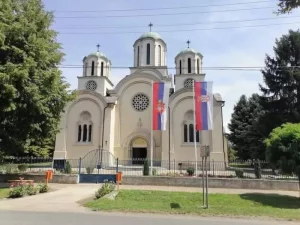
The Orthodox temple dedicated to the Holy Doctors, Kuzman and Damjan, and the village house in Srem, also known as the Savic house, are of exceptional cultural importance. This Baroque-style church was built in 1754, and the cannonballs fired at the village during the revolutionary events of 1848 can still be seen on the facades. In the interior, there is a richly carved iconostasis made by Marko Gavrilović and his son Arsenij Marković. In 1773, for its major part, it was painted by Teodor Kračun, the greatest Serbian Baroque painter, as well as Stefan Gavrilović (1800). Three icons from the old Nestin iconostasis from 1741, the work of zoographer Stanoje Popović, remain conserved.
The icon from the throne of the Virgin, painted by priest Rafailo Miloradović from Bačka Pa-lanka in 1724 for the Rašković family is priceless. The icon painter left a note on the back of the painting in which he points out the troubles that befell him while painting. Soon, the Holy Virgin of Neštin began to shed tears, and today it is one of the most famous miraculous weeping icons.
The hospitality of the inhabitants and a variety of local food, prepared from the food grown in the village gardens, in addition to everything mentioned above, complete the picture of Neština and invite you to visit it.
SREM HOUSE – SAVIĆ HOUSE
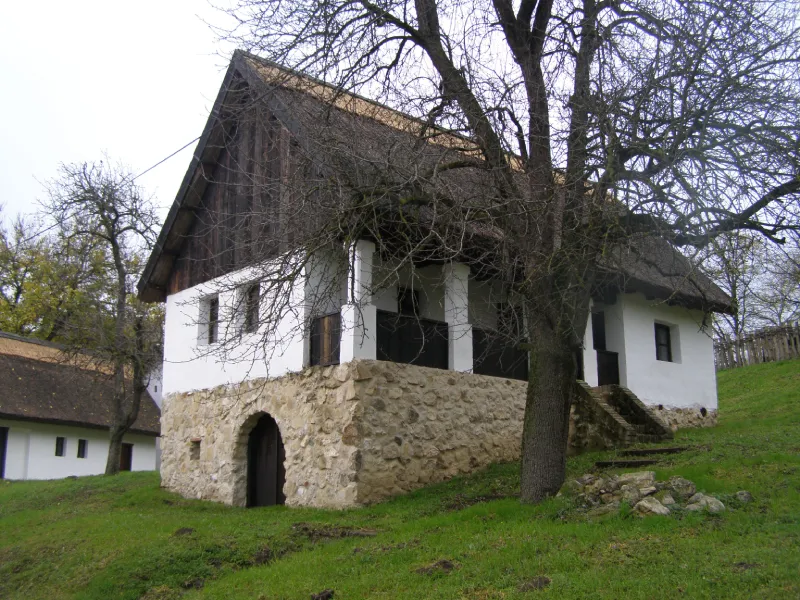
Neštin Savić house from 1743 represents a developed type of country house that appeared in the Srem area in the 18th century. It is located in the part of the village known as Dolja.
It is one-story, built in the bondruk system (wooden posts attached to oak foundation beams) with wattle filling, plastered with mud, and covered with reed. As it is located on a gentle slope, the basement is in the front, built with broken sandstone. As for the layout, it is traditionally three-part, room-kitchen-room. The rooms are small, and there is an open fireplace in the kitchen area.
A special feature is an open corridor – gong (gonk) with hand-carved oak pillars and arches on the front and longitudinal facades. In the attic, there is a stylistically unusual and richly decorated porch. The woodwork is made of oak and the front door is in a “herringbone” shape.
The age, rarity, and processing of wooden parts contribute to its extraordinary importance. A porch on the street side is typical of traditional houses in Srem, but, unfortunately, it disappeared over time.
By choosing materials and the way of processing them, the builder created a unique whole, and thanks to his pursuit of refinement, the harmony of shape, composition, and color were achieved.
The house is a cultural monument of exceptional importance for the Republic of Serbia. It was bought from the Savić family and today it is owned by the AP Vojvodina, while the beneficiary is the Provincial Institute for the Protection of Cultural Monuments, Petrovaradin.